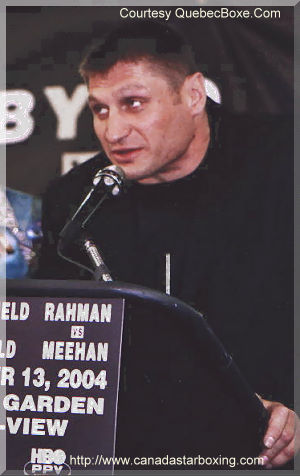
ANDREW GOLOTA
A QUICK GLIMPSE OF ANDREW GOLOTA
38 Wins – 4 Losses – 31 KOs
Fast Facts
- Born January 5, 1968
- Age 36
- Born in Warsaw, Poland
- Resides in Chicago, Illinois, USA
- 6′ 4″
- 79″ reach
- Trained by Sam Colonna
Professional Career Debut
Age 24
February 7, 1992
Amateur and Personal Background
- Andrew Golota began boxing at age 13
- Captured seven Polish national amateur championships
- Relocated to Chicago when he turned pro in 1992 (winning his first 27 starts – 24 by knockout)
PROFILE AND BIO
Andrew Golota first garnered national attention when he bit Samson Po’uha en route to a fifth-round technical knockout victory in May 1995.
In his biggest victory as a pro, he battered Emanuel Steward-trained Danell Nicholson en route to an eighth round TKO in March 1996, despite getting himself disqualified for a head butt.
The Warsaw native would not be so lucky facing former undisputed heavyweight champion, Riddick Bowe, against whom he twice fouled out of high-profile bouts he was winning in 1996. The first meeting between the two in July stands on its own as a fight that will go down in history due to the mayhem that engulfed Madison Square Garden following the proceedings.
Determined, he performed better than most could have imagined. His combination punching looked like the best in the division, and his ability to slide to either side and deliver punches left Bowe, one of the great heavyweights of all time, confused and covering up on the ropes. Golota was on his way to registering a shocking upset before things turned sour. He was rocking Bowe in the fourth round when a low blow interrupted the action. The referee penalized Golota a point and gave Bowe time to recuperate. The same thing occurred late in the sixth round and a second point was deducted. Midway through the seventh, Golota struck below the belt for his third point deduction. Inexplicably, with twenty-seven seconds remaining in the round, he was disqualified after landing his final illegal blow that left Bowe lying on his back in agony.
A wave of spectators stormed the ring, catching Madison Square Garden security off guard. As Andrew returned to his corner, he was attacked by members of Bowe’s entourage and was struck on the back of the head with a portable phone.
For the rematch five months later, his handlers took extra steps to ensure that their charge’s blows would stay in the legitimate target area. A pair of specially-made trunks were fixed to a rounded “body-punching” bag at the gym where he trained. The extra measures taken did not help. A battered Bowe, down twice in the fight and out on his feet in the closing rounds, won by ninth-round disqualification after being struck low again.
In October 1997, Andrew got a shot at World Boxing Council (WBC) heavyweight champion, Lennox Lewis. In a shocking result, Lewis knocked him out at 95 seconds of the opening round. Golota came out tentative and went down the first time at the one-minute mark. He gave his best to be competitive, but never recovered and went down again. The referee stopped the bout shortly thereafter.
After the crushing first-round knockout, he won six consecutive bouts, including hard-fought, unanimous 10-round decision victories over Corey Sanders and Tim Witherspoon in July and October 1998, respectively.
The Sanders slugfest was a bloody, one sided-war. He could never relax as Sanders, despite fighting with a nasty gash over his left eye from the third round on, showed plenty of spunk by continually trying to fight back. In the end, however, Golota achieved victory.
He had an even easier time outpointing Witherspoon, the former world heavyweight champion. In what was considered a tough assignment, he boxed magnificently while avoiding ‘Spoon’s right hand to again win.
In January 1999, he won his third consecutive unanimous 10-round decision, this one over Jesse Ferguson. However, he suffered a come-from-ahead TKO 10-round loss to then North American Boxing Federation (NABF) heavyweight champion, Michael Grant in November 1999.
Grant was down, and almost out, twice in the first round, but Grant fought on and floored Andrew in round ten. He got up fast and appeared steady on his feet before the referee asked him if he wanted to continue. He said “no” twice and the bout was halted in the tenth round, at which time he had been ahead on the scorecards.
He registered a third-round TKO over Marcus Rhode in April 2000. After knocking him down three times in the first round, he dropped Rhode twice in the second. In the third, he landed a hard right followed by two combinations that drove Rhode through the ropes, and the bout was stopped.
In June 2000, he built up an early lead and withstood a late rally to win a unanimous decision over former world champion, Orlin Norris.
In October 2000, he fought Mike Tyson the fight was declared a no contest after he did not answer the bell for the third round due to injuries, the fight was declared a no contest.
After nearly a three-year hiatus, in August 2003 he stopped Brian Nix (TKO 7) and the following November he stopped Terrance Lewis (TKO 6).
In April 2004, Andrew Golota had his second chance to win a world heavyweight championship; this time, Chris Byrd’s IBF crown. Most boxing experts felt that Byrd would frustrate him by using his superior boxing skills to wear the big man down, but Andrew gave his best performance 1996 when he faced Bowe in those two epic clashes. He avoided fouling, kept his composure, boxed efficiently, and many people thought he won the match. The fight went the 12-round distance, but the judges could not determine a winner. Each fighter won on one scorecard and a tie was recorded on the third scorecard.
His fine performance has earned him another world title fight against WBA Champion, John Ruiz on November 13. “I am proud to be part of the show,” he said. “I want to win the WBA title and be part of something that unifies a real champion.”
He put Ruiz and his trainer/manager, Norman Stone on notice. “Nothing personal Johnny, I love you. You too, Stoney. But you’re in my way and it’s going to go my way November 13.”