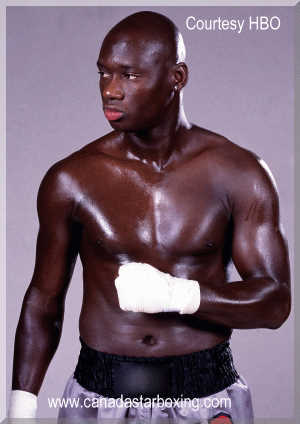
ANTONIO TARVER
A QUICK GLIMPSE OF “Magic Man” ANTONIO TARVER
23 Wins – 3 Losses – 18 KO’s
Fast Facts
- Age 36
- Born November 21, 1968
- Born in Orlando, Florida
- Resides in Tampa, Florida
- Stands 6’2 1/2 “
- Trained by Buddy McGirt
- Promoted by Star Boxing (Joe Deguardia)
Professional Career Highlights
- WBC Light Heavyweight Title
- WBA Light Heavyweight Title
- IBO Light Heavyweight Title
- IBA Light Heavyweight Title
- NBA Light Heavyweight Title
- Pro debut at age 28 on February 18, 1997
Personal and Amateur Background
- 1996 Olympic Bronze Medalist, 178 lbs.
- 1995 World Amateur Champion, 178 lbs.
- 1995 Pan American Games Champion, 178 lbs.
- Five-Time U.S. National Amateur Champion
- Began boxing at age 10 at a local Boys’ Club, but gave up the sport 5 years later when his parents relocated.
- Concentrated on football and other teenage pursuits during high school. He was motivated into boxing when he saw his old rival Jones fighting for the United States in the Seoul Olympic Games.
- Tarver tore through the amateur ranks in the next eight years, earning a spot on the US Olympic team that went to Atlanta in 1996. He made history in 1996 becoming the only US amateur boxer ever to win the national championships, the Pan-Am games and the world championships all in one year.
- At the world championships, he beat future cruiserweight champion, Vassiliy Jirov in the semi-finals and then Diosvany Vega in the finals, four months prior to the Olympics.
- Felt he was cheated at the Olympic Games where he eventually won a Bronze Medal. “I dominated the second round of the fight I lost (to Jirov) and came out two points down. I’ve always had great defense and when I look back at the fight now, I don’t see he he was scoring any blows.”
Strengths
- A tallsouthpaw with good skills and speed
- Good punching power
- Strong jab
- Punches in combinations
- Poised and patient
- Strong amateur background
FIGHT TO THE FINISH TARVER vs HOPKINS
Fight to the Finish
Antonio Tarver vs Bernard Hopkins
12-Round Light Heavyweight Bout
Saturday, June 10, 2006
Distributed by Canadastar Boxing Inc.
To Canadian Commercial Locations
On Closed Circuit-Pay Per View
ANTONIO TARVER PROFILE AND BIO
Updated Post Tarver vs Jones 3 (October 2005)
They call World Light Heavyweight Champion, Antonio Tarver “Magic Man” for a number of reasons – maybe it’s because he has made 23 opponents disappear in the ring; maybe it’s because his remarkable skills recall the sleight of hand made famous by Houdini. But more likely, Tarver is known as the “Magic Man” because in a short four year period, he has helped take a sport in the doldrums to the next level, exciting mainstream, sports fans as well as hardcore fight followers – a task many believed was impossible. That’s “Magic”.
During his first five years in the sport which began at the age of ten, he happened to fight a young man who would play a major role in his career later on – Roy Jones, Jr.
Following Tarver’s second-round TKO of Joaquin Garcia in his professional debut in 1997, he moved up the ranks without the media spotlight that was shining on some of his fellow Olympians. Tarver came up the hard way, fighting in front of demanding crowds in such boxing hotspots as the legendary Blue Horizon in Philadelphia. But these fights steeled Tarver’s resolve and helped make him the fighter he is today.
There was something missing though, and it was evident in June 2000, when the 16-0 Tarver suffered the first defeat of his professional career to Eric Harding. In a hard fought 12-round title eliminator, Tarver dominated the first half of the bout, but after having his jaw broken in the ninth round, it became an uphill battle, and Harding finished strong, knocking Tarver down in the 11th round en route to the decision win. It was a tough defeat to swallow, but Tarver showed his championship heart.
“I’m not making excuses, but if you look at the fight, I dominated until my jaw got broke,” said Tarver. “With the broken jaw, I was unable to finish as strongly as I wanted to. Look at the first nine rounds, it’s obvious who the better fighter was.”
Looking to erase the mistakes of the past to become a complete fighting machine from bell to bell, Tarver enlisted the services of former world champion, Buddy McGirt and conditioning coach, Dudley Pierce to help him reach those goals.
After allowing his jaw to heal, the new Team Tarver, which also includes his promoter Joe DeGuardia and Star Boxing, got back to work in 2001. The results were amazing. Previously unbeaten Lincoln Carter and highly regarded Chris Johnson were both stopped in devastating fashion, and in January 2002, Tarver earned a shot at the IBF Light Heavyweight Title with a 12-round decision win over Reggie Johnson, a victory that also earned Antonio the NABF and USBA 175-pound titles.
In July 2002, Antonio Tarver put his guaranteed title shot on the line against the only man to ever beat him, Eric Harding. It was a risky move, but one that only true champions will make. In just five rounds, Tarver avenged his defeat via TKO.
Nine months later in April 2003, Tarver finally got his world title shot and made the most of it, shutting out former world champion, Montell Griffin over 12 rounds to win the vacant WBC and IBF titles.
But, there was something missing, and that was Roy Jones, Jr.
In November 2003, Tarver finally pushed Jones into a title fight, and what a fight it was, a 12-round battle that saw the pound for pound king punished by Tarver like he had never been before. Yet when the decision was announced, Jones had regained his championship belts via a highly controversial majority decision.
A rematch came in May 2004, and with Tarver’s now immortal question, “You got any excuses tonight, Roy?” ringing in the ears of fight fans, one of the most memorable nights in recent history kicked off. Two rounds later, Tarver landed the shot heard ’round the boxing world, a single left hand that knocked Jones out for the first time in his magnificient career, and after years of blood, sweat, and tears, the world found out what Antonio Tarver already knew. He was a star.
Antonio was boxing’s talk of the town after defeating Jones, and he fulfilled numerous television, radio, and print media obligations after his amazing victory. And while some fighters would have been content with a couple of easy title defenses against unknown opponents, for Tarver’s first fight back in December 2004, he would face the second man to send Jones crashing to the canvas, Glen Johnson.
It was a bout that was an early Christmas present to fight fans, as both warriors – unquestionably the two best 175-pounders in the world – battled it out for 12 hard-fought rounds. Unfortunately, Tarver would lose a highly controversial split decision that night, a verdict many at ringside felt was unjust.
This is Antonio Tarver we’re talking about though, and past istory showed that he was always twice as dangerous in a rematch. In June 2005, Tarver regained his light heavyweight championship by a 12-round unanimous decision over Johnson, re-establishing his supremacy at 175 pounds.
In his most recent bout in October 2005, Tarver won a decision in the third bout of the Tarver vs Jones trilogy.