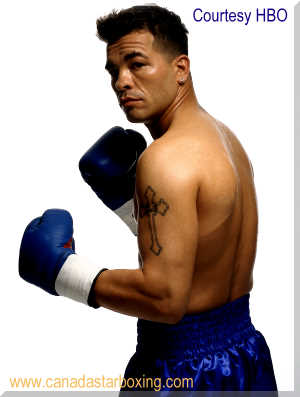
INTERVIEW LOOKING BACK WITH
ARTURO GATTI
By: W.J. Rutherford, Editor-in-Chief
Canadian Pro Boxing Scene
The fourth of six children born in Canada to Italian immigrants, Giovanni and Ida Gatti, Arturo grew up on Joliette St. in the heart of Montreal’s little Italy. He first entered a boxing gym at the age of seven, and the rest, as they say, is history.
Q. Congratulations, how’s it feel to be named the Canadian Pro Boxing Scene Fighter of the Year for 2003?
AG. Thank you very much. It means a lot to me to know I’m looked at that way, not only in the ring but outside the ring also.
Q. How did you get your start in boxing?
AG. I followed my brother Joe into it. I played soccer, I played hockey and at the age of fifteen, after my father passed away, I realized boxing would be a good way for me to make a living. I enjoyed it. I was good at it and I pursued it. Here I am, I won a world title, I live in New Jersey now. I fight for big money and I’m very happy about it.
| Q. Who was your very first amateur trainer in Montreal?AG. Dave Campanile. One of the things that bothers me a lot is that I wasn’t able to attend his funeral. He’s one of the greatest men in my life. He took care of me since I was a little boy eight years old. I was training with him at the Olympic Boxing Club and then my father passed and he kept me in the game. I owe a lot to Dave Campanile. It’s upsetting knowing that I wasn’t able to attend the funeral because I was like two or three weeks away from fighting Oscar De La Hoya. It just kills me to think that I wasn’t able to be there. Dave has been like a father to me. | |
| Amateur career and turning pro . . .Q. How many amateur fights did you have?AG. I don’t know, maybe 75 fights. At the most 15 losses. I won three Golden Gloves, two Canadian (Intermediate titles). I won the Gaelic championship. I fought in the World Championship in Peru. When I was 19 years old, I lost against Michael Strange in the Canadian Olympic trials (for the 1992 Barcelona Games), and I just decided to move on. I think I made the right decision. Do I regret not going to the Olympics? To be honest, being a Canadian or being an American and going to the Olympics are two different stories. You get more out of winning a medal as an American. It’s just the way the sport is looked at in Canada.Q. Where did you go when you first came to the States?AG. I was in Jersey City … Tough neighborhood, very tough neighborhood. Then I trained in Brooklyn at Gleason’s. Gleason’s, if you make out of there alright, you become a champ. That’s what happened to me. When you spart there it’s tougher than a real fight! Gym wars, big time! Everybody’s competing for the same thing at your level.Q. When did you hook up with Pat Lynch?AG. My brother Joe was managed by Pat first, and that’s how I got to meet him. He was more worried about my well-being than anything else. I got really lucky to meet Pat Lynch.Q. Who game you your first break in the pro fight game?AG. Main Events. The first time they saw me fight, they contacted Pat and wanted to sign me up. I’ve een with them ever since.Q. I think they got their money’s worth!AG. (Laughs) Yah, definitely! I think it’s time to pay some back! | |
| Q. Two of the three fights in that series were Ring Magazine fights of the year. The only other series that can claim that honour are Graziano/Zale (’46, ’47) and Robinson/Basillio (’57, ’58)AG. Thanks. I’ve been told that. I love the game and Micky’s just the same guy that I am — we fought with our hearts.Q. Tell us a little about the series. Manny Steward described the ninth round of the first fight as the round of the century.AG. In the ninth round he caught me, and that’s his best shot, and with my experience, I took a knee down and took the count and came back and won the tenth. I still feel that the fight could have gone either way, but you know, things happen for a reason. I’m kind’a glad I didn’t get the decision.Q. It’s not that often that you hear a boxer say he’s glad he didn’t get the decision. But in your case the next two fights were great for both your careers.AG. Yah, my stock really skyrocketed after those fights. I made some money and I’ve learned a lot from those fights. It’s changed me as a fighter. I have to admit that’s one loss I will never forget. | |
| Q. Can you describe to the average Joe boxing fan, what it feels like to take one hard in the liver?AG. It’s a punch that you can’t recuperate (from). You know a head shot, you can shake it off and be fine with it, but a body shot, it’s just there and it’s not going away. In the fight I took a lot of them, and in the ninth round, I was just smart enough to take the knee down. If it had been earlier in my career, I would have been too brave to take the knee down and I would probably have been stoped. I was still hurting in the tenth when I came back to win it, and I was hurting for a couple of weeks actually. And I still have a little lump on my rib that’s going to stay there, and I remember Micky Ward’s left hood! (Laughs).Q. In the second fight it looked like you were sitting down a little lower so his body attack wasn’t effective. You knocked Ward down early. Were you surprised he got back up and fought back as well as he did?AG. I knew it would be a tough fight just like the other one. No doubt in my mind he’s gonna be back! During that fight I broke my hand in the third round, but the only reason I was able to continue with no problem, is that I had a plate in my hand that held everything together. Not like the third fight. I really had trouble to finish that fight because of my hand. But I still won the fight I feel. I just took away the body shots and that’s what changed the whole fight.Q. In the third fight, it looked like things were yoing your way until you hurt your hand in the fourth.AG. No, I hurt my hand in the third. I broke my fourth metacarpal, so I sent back to Buddy (McGirt) and I whispered in his ear ’cause I didn’t want anybody to know. But that was the knuckle, that was nothing. I’ve had a bad knuckle all my professional boxing career. So it wasn’t a problem. But in the fourth round, when I threw the uppercut, I hit Micky on the hip — forget about it! I shattered my hand. That really killed me. I thought that was it.Q. I know Buddy asked you between rounds if you could continue and you just gritted your teeth and went back out.AG. (Laughs) I learned something from myself. It’s going to take more than a broken hand for me to stop. | |