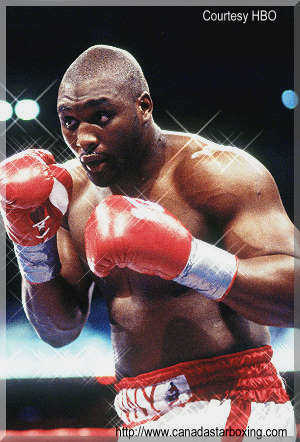
DANNY WILLIAMS
A QUICK GLIMPSE OF DANNY “Legend Killer” WILLIAMS
32 Wins – 3 Losses – 27 KO’s
Fast Facts
- Born July 13, 1973
- 31 years old
- Born in London, England
- Height: 6′ 1″
- 66″ reach
- Trained By Jim MCDonnell
- Managed and promoted by Frank Warren, Sports Network
Professional Debut
October 21, 1995
Age 22
Career Highlights
- World Boxing Union (WBU) International Heavyweight Champion
- Former British Heavyweight Champion
- Former British Commonwealth (British Empire) Heavyweight Champion
- Former WBO Intercontinental Heavyweight Champion
- 35 Professional Fights
Personal Background
- Spends his time away from the ring with his two young daughters
- Hopes to duplicate the success of his idol, Muhammad Ali, by winning the heavyweight title.
Amateur Background
- Reported 29-6 amateur career record.
- Captured gold medals in Italy and Greece (1991), and at ’94 Liverpool Multinational tournament. Won bronze medals in Finland (’93) and at the ’93 European Championships.
DANNY WILLIAMS PROFILE AND BIO
Boxing is simple – get in the ring and beat the other guy. It should be easy, but then being human gets in the way.
“I used to get so nervous before a fight. I would hardly be able to eat,” Danny Williams said. “Sometimes, I would burst into tears because of the pressure. Once, I was at some traffic lights and I could not stop the tears. I had to pretend something was in my eye as people walked passed me.
“It is because of my own expectations of myself. Since I was a boy, I have been told I am going to be heavyweight champion of the world. I want it so badly that when I think something is messing it up, I get so upset that I have smashed stuff up at home thinking about it.”
Courage and determination have led Danny Williams to the WBU, the British and the British Commonwealth heavyweight titles.
The signature fight of Williams’ 10-year pro career came in October 2001. He was in a brawl against Mark Potter with the vacant British heavyweight and his own British Commonwealth belts on the line. The London native missed with a right cross and his arm popped out of its socket. Williams persisted and continued with the use of just his left arm. Many ringsiders begged Williams to quit. Despite the searing pain, Williams began working his jab.
By the sixth round, he could not lift his right glove above his waist. Potter relentlessly pressed the action until a left-hand smash left Potter semi-conscious on the canvas.
In October 1995 at age 22, he registered a second-round TKO over Vance Idiens in his professional debut in England.
Williams completed a successful rookie campaign by stopping Joey Paladino in the opening round in December 1995.
After defeating his initial 14 opponents (12 by knockout), Williams closed out his fourth pro season in October 1998, by winning his first pro title and captured the vacant World Boxing Organization (WBO) Intercontinental heavyweight crown with a 12-round decision over Antoine Palatis.
In April 1999, he lost a 12-round decision against Julius Francis, costing him the British Commonwealth heavyweight title and ending his 15-bout winning streak.
After an opening-round destruction over Ferenc Deak in October 1999, he received another shot at the British Commonwealth crown when he faced Harry Senior in December 1999. After a grueling 12 rounds, Williams emerged victorious and left the ring with his second pro title.
Following five consecutive knockouts in 2000, Williams successfully defended his British Commonwealth title for the second time in June 2001 with a 32-second knockout over previously undefeated Kali Meehan.
In a rematch in July 2001, he knocked out Francis in the fourth round, successfully defending his British Commonwealth title for a third time.
After a second-round TKO over Shawn Robinson in December 2001, he fought his first of three matches against Michael Sprott in February 2002. He launched a sustained assault at the start of the seventh round that produced a stoppage 26 seconds into the round.
Next was a September 2002 bout against Keith Long. Following 12 rounds, he won a points decision.
In February 2003, he challenged defending European heavyweight champion Sinan Samilsam. After watching Williams hit the canvas four times, his corner threw in the towel in the sixth round when he was been pinned on the ropes by a series of heavy punches. He blamed the defeat on a bout of shingles that had kept him bedridden in the build up to the showdown.
In April 2003, he scored a fourth-round TKO over Bob Mirovic and retaineed his British Commonwealth title for a sixth time.
He fought a rematch against Sprott in September 2003. In the fifth round, when Sprott dropped his hands to complain about low blows, Williams scored a knockdown with a left hook to the chin. The referee stopped the bout without a count. Following the controversial ending, the British Boxing Board ordered an immediate rematch.
The two fighters squared off a third time in January 2004 and he dropped a 12-round decision and surrendered his British Commonwealth title.
In April 2004, he registered a 1st-round TKO against Ratko Draskovic.
He locked gloves with Augustine N’Gou for the vacant World Boxing Union (WBU) International heavyweight title in May 2004. Claiming he had a torn bicep, N’Gou quit at the end of round three.
July 2004 marks the biggest win of his career when he knocked out Mike Tyson. In a slugfest while the fight lasted, Tyson stormed out in the 1st with thunderous punches, but Williams held on. Williams hurt Tyson in the fourth round with a couple of right hands and landed an estimated 27 straight punches before finally putting him down, and out, at 2:51 of the fourth round.